
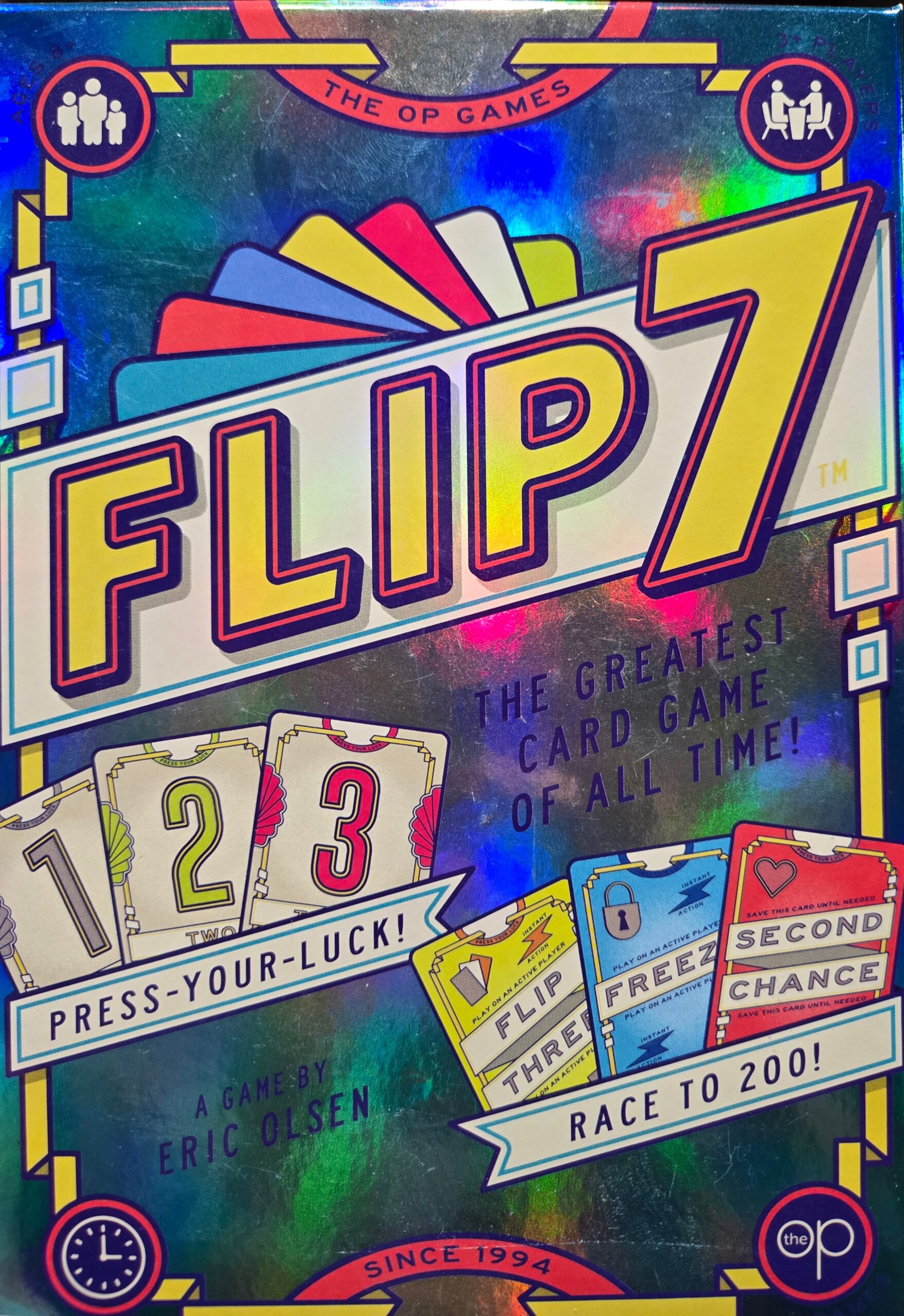
If you’re looking for a fast-paced, push-your-luck card game that’s perfect for parties, family game night, or just a quick round with friends, Flip 7 is one of the most exciting options you’ll find. With simple rules, big decisions, and plenty of tension on every card flip, this game is easy to learn but hard to put down. Continue to read as we break down what Flip 7 is, how to play, scoring tips, and what makes this game a standout in the world of modern card games.
What is Flip 7?
Flip 7 is a press-your-luck card game designed by Eric Olsen and published by The Op Games in 2024. The objective is simple: be the first player to score 200 points over multiple rounds by collecting as many valuable cards as possible — without duplicating a number card.
At its heart, Flip 7 is about risk and reward. Do you take another flip to rack up points… or do you play it safe and stay with what you’ve got? That choice is the source of most of the fun and tension in the game.
What’s in the Box?
A standard Flip 7 deck includes a total of 94 cards:
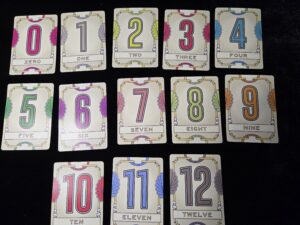
79 number cards
0 – 12, with the same number of cards as the numerical value such as: six cards of the number 6, seven cards of the number 7… etc.
The zero card is an exception and there is only one copy of this card.
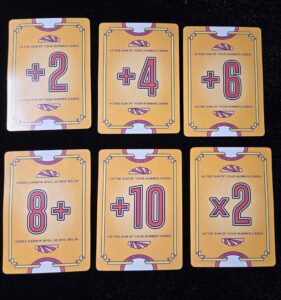
6 score modifier cards:
+2, +4, +6, +8, +10, and x2
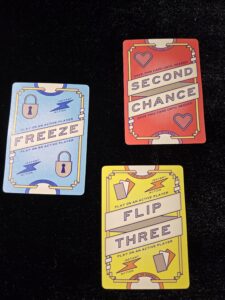
9 Action cards consisting of three of each:
Freeze
Flip Three
Second Chance
How to play Flip 7?
Flip 7 can be played with 2 – 18 players. If you want more than 18 players you will need another copy of the game. The object of the game is to be the first to earn 200 points.
Setup
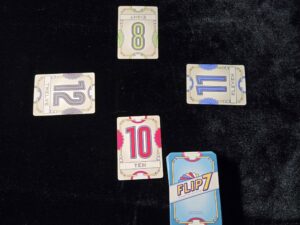
- Grab a sheet of blank paper and a pen for your score keeper.
- Shuffle the deck and choose a dealer.
- The dealer deals one card to each player, face-up.
- If any Action cards (Freeze, Flip Three, Second Chance) are delt, resolve them immediately before continuing.
- After each player has one card, the real gameplay begins.
Turn Sequence
On your turn, you have two choices:
Hit – Take another card from the deck.
- If it’s a number card matching a number you’ve already flipped, you bust and score zero for the round.
- If it’s a new number, place it in front of you — the higher your total, the better your score!
- Modifier cards (+2, +4, +6, +8, +10, and x2) go above your number cards and don’t cause busts.
Stay – End your turn and score the points from your current cards and modifiers. You’re out for the rest of that round.
Ending a Round
A round ends in one of three ways:
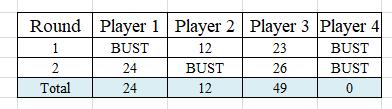
Stay – write down total points the player chose to keep. The player discards their cards and they are out for the rest of the round
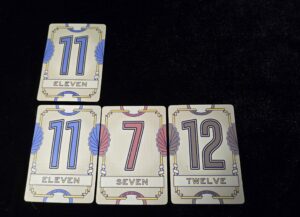
Bust – A player gets a matching number. The player discards all cards and is out for the rest of the round scoring zero.
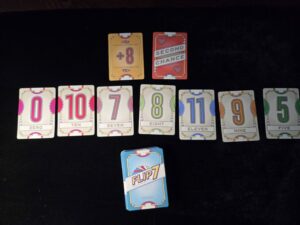
Someone flips 7 unique number cards, triggering an immediate bonus, and end of round
Getting seven unique number cards (without duplicates) ends the round instantly and earns a 15-point bonus — that’s where the name Flip 7 comes from!
How to Play Action and Modifier Cards
Action Cards
Action cards must be resolved the instant an active player is fliped the card. The player can choose to keep the card or give it to another player. If there is only one active player left in the round the cards must be played on that active player. The second chance is an exception to this rule in that a player can choose to hold and play it any time during the round.
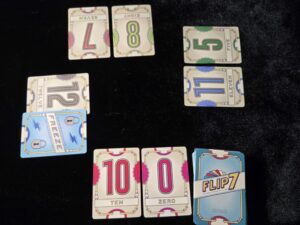
Freeze: You or another active player instantly score points and are out for the rest of the round.
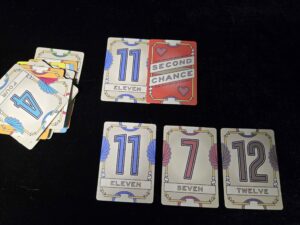
Second Chance: Place this card above all of your unique number cards until you need it. Once you flip a duplicate number card — discard the second chance and the duplicate number card fliped and continue the round with the next active player. Important – you can only have one second chance card in your hand at a time. If you draw a duplicate you must give it to another active player or discard the card. ALL second chance cards are discarded at the end of the round even if they were not played.
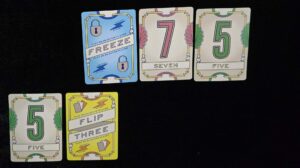
Flip Three: You or another active player must flip three additional cards — risky but potentially rewarding. Stop if the player completes 7 unique number cards successfully. If action cards are drawn during the flips they count toward the total number of 3 cards needed. Set aside action cards then resolve action cards after all three cards are drawn or the player busts. Players that bust must choose another active player to receive action cards drawn.
Modifier Cards
These modifier cards give bonus points. Some add flat amounts (+2, +4, etc.), while x2 doubles your current total — but only if you don’t bust!
How do I Score Flip 7?
At the end of each round:
- Add up all your number cards.
- Apply the x2 modifier (if any).
- Add any + bonus cards.
- If you flipped 7 unique numbers, add +15 bonus points.
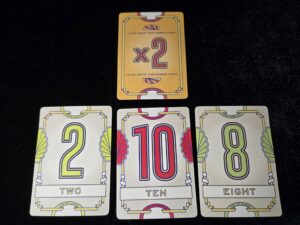
- If this round was to score:
- Player 1 gets 40 points
- 2+10+8 = 20 then x2 for a total of 40
- If Player 1 also had a +8 then scoring would be 48
- 2+10+8 =20 then x2 for 40 then +8 for a total of 48
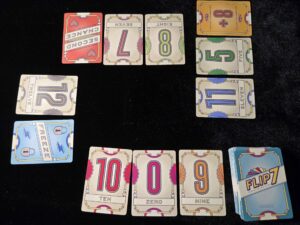
- Player 1 gets 19 points (10+0+9)
- Player 2 gets 12 points (12)
- Player 3 gets 15 points (8+7)
- Player 4 gets 24 points (11+5+8)
- Player 1 would get 73 points.
- 0+10+7+8+11+9+5 = 50 plus +8 then +15 bonus points
The game continues until a player hits 200 points. The highest score wins!
As an easy way to keep score checkout our use our free online score keeper.
Why is Flip 7 So Popular?
Based on player and blog reviews, games ranking well for Flip 7 searches share a few key traits:
Fast, Fun Gameplay
Turns are quick, and decisions matter — weighing risk vs. reward creates excitement every flip.
Accessible for All Ages
Rules are simple enough for kids (recommended ages 8+) yet strategic enough to entertain adults.
Social and Interactive
Action cards let you help or hinder others — great for group play and keeping everyone engaged.
Easy to Learn, Hard to Master
Beginners can start playing in minutes, but seasoned players will love the tension and choice.
Flip 7 Variants & Tips
Beginner-friendly tip:
Score early if you already have modifiers — it often beats risking a bust late in a round.
Advanced strategy:
Watch the cards already flipped. As duplicates become more likely, adjust your risk tolerance accordingly.
Large group play:
Flip 7 scales up to 18 players, and you can even mix in additional decks for more massive game nights!
Is the game Flip 7 worth the money?
Flip 7 is one of the most addictive modern card games for groups of all sizes. It combines luck, risk-taking, and just enough strategy to keep every round exciting. Whether you’re playing with family, friends, or new players, you’ll find the mix of suspense and celebration irresistible. If you want a card game that’s easy to learn and endlessly replayable — this one’s definitely worth flipping over! If you enjoy card games try others we have reviewed by clicking here!
Other Games You May Like if You Like Flip 7
If you have a lot of fun with Flip 7 we recommend the games below based on the gameplay of Flip 7. Of the games listed below we highly recommend Silver Bullet because it is a little more competitive and adds a memory challenge.
Play Nine Card Game
Play Nine is a 2 – 6 player recommended minimum age is 8. The object of Play Nine is to have the lowest score. You start the game with 8 cards face down placed in front of you and turn over two. Players replace or turn over a card on every turn.
Silver Bullet
Silver Bullet is a great game for 2 – 4 players. The object of the game is to have the lowest total. Five cards are dealt face down to each player. You get to look at two cards but cannot turn them face up. Players can either take the top card of the deck or the top card of the discard pile. Each card will have an ability that the player can choose to complete or discard, the bullet mechanic and you can sabotage other player boards. This is a great game that will challenge your memory, has a great werewolf theme and nice art.
No Thanks
No Thanks is a card game that plays 2 – 7 players. Each player is trying to acquire the least points possible. This game adds a fun element of chips that entices other players to take higher-numbered cards. Sometimes there is a strategic advantage to taking a high card and other times it is better to pass with a chip. If you collect cards in sequence, only the lowest one counts against your score. No thanks is a lot of fun and we hope you give it a try!